

















The Italian health system (SSN – Servizio Sanitario Nazionale) is one of the advanced healthcare structures in Europe, which, relying on universal services, provides free or subsidized healthcare to all citizens and legal residents. This healthcare system requires a wide range of paramedical personnel to provide accurate and specialized services. In recent years, the shortage of specialized personnel in paramedical fields has caused Italy to open the doors of its healthcare system to foreign professionals, including Iranians.
For paramedical graduates in Iran, this situation is considered a golden opportunity to enter the European job market, obtain work residency, and build a secure and professional future in Italy.
What are the paramedical fields needed in Italy?
Some of the most important paramedical branches in demand in the Italian healthcare system are:
Operating room technicians
Laboratory technicians
Radiology experts
Physiotherapists
Occupational therapists
Clinical psychologists
Pharmacists

The demand for biomedical laboratory technicians, radiology technicians, physiotherapists, occupational therapists, and other similar professions is significantly increasing. For some fields, such as radiology technicians, there is still a sufficient number of graduates, but in other areas, a serious need is felt.
Many of these professions are on the list of (Regulated Professions) and require going through formal degree verification procedures.
Elderly caregivers and nurses' aides (Assistenti Sanitari /OSS)
- Home caregivers for the elderly (Badanti)
- Support staff in nursing homes and care centers
These jobs are in high demand and, for applicants who do not have a formal nursing degree, they are considered a suitable starting point for faster entry into the Italian healthcare job market.
Main causes of the widespread need for healthcare personnel
- Aging population: With the trend of population aging—by 2050, half of the population will be over 65—the need for long-term care increases.
- Decrease in applicants for studying healthcare fields: The desire to enter these professions has decreased; especially in nursing, the ratio of applicants to available places has become very low.
- Professional exodus and mass retirements: Many nurses and doctors are nearing retirement.
- Specialization gap: Sectors such as emergency, radiotherapy, and pathology face particular shortages.
Most provinces and hospitals in Italy are in search of qualified doctors, nurses, paramedics, and healthcare assistants. This shortage of human resources provides a very good opportunity for Extra UE healthcare personnel to enter the official job market of this country through degree equivalency, Italian language training, and obtaining a work visa.
Italy now needs skilled healthcare personnel more than ever; if you carefully follow the process of degree equivalency, language learning, and administrative procedures, this can be an excellent starting point for your career migration.
Conditions for paramedical work immigration to Italy
If you have studied in one of the paramedical fields and wish to enter the European professional job market, Italy can be an attractive and opportunity-filled destination for you. The Italian health system, relying on multidisciplinary medical teams, considers paramedics as an integral part of providing healthcare services. In recent years, due to the shortage of specialized personnel and the retirement of healthcare workers, the need for paramedics in Italian medical centers has increased significantly. Below, we examine the general and specific conditions for Extra UE paramedical work immigration to Italy:
General and specific conditions for paramedics
- Valid and assessable educational degree: Having an official university degree (at least a bachelor’s degree) in one of the paramedical fields such as laboratory sciences, radiology (medical imaging), physiotherapy, optometry, speech therapy, audiology, nutritional sciences, emergency medicine, occupational therapy from accredited Iranian universities is the main prerequisite. These degrees must be officially translatable in Iran and recognized by the Italian Ministry of Health in Italy.
- Degree equivalency by the Italian Ministry of Health: (Riconoscimento del Titolo Estero) Degree equivalency is done by submitting documents to the Italian Ministry of Health. In some fields, in addition to document evaluation, a written test or oral interview is also conducted.
- Work experience (preferably at least 3 years): Having work experience in hospitals or reputable medical centers significantly increases the chance of receiving a job offer and work permit approval.
- Proficiency in the Italian language: For working in the Italian healthcare system, proficiency in Italian is essential. Usually, level B2 is required, as they are in direct contact with patients.
- No criminal record: Providing a certificate of no criminal record to obtain a work visa and residence permit.
- Physical and mental health: Being in complete good health to perform the medical profession, confirmed by a medical certificate.
- Registration with the relevant professional body: Such as the Ordine TSRM-PSTRP for radiologists and other paramedics.
- Providing an official job offer from an Italian hospital or medical center.
Age
There is no specific age limit for work immigration, but generally priority is given to individuals under 45 years old.
Residency and accompanying family conditions
- After obtaining a work visa and entering Italy, you must apply for a work residence permit (Permesso di soggiorno) within a maximum of 8 days.
- It is possible to apply for accompanying residence for a spouse and children.
- After 5 years of legal residence and paying taxes, it is possible to convert temporary residence to permanent residence.
Workplaces for paramedics in Italy
Paramedics in Italy, depending on their specialty, work in various centers within the country’s health system. Their most common workplaces include:
- Public and private hospitals
- Specialist and super-specialist clinics
- Medical and diagnostic laboratories
- Rehabilitation and physiotherapy centers
- Nursing homes and long-term care centers
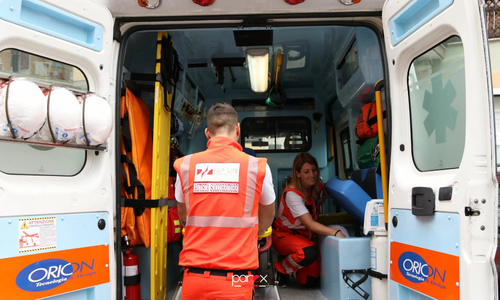
- Emergency units and pre-hospital care
- Local health authorities (ASL)
In Italy, due to the growing elderly population, the need for specialized paramedical services such as physiotherapists, radiologists, and speech therapists is constantly increasing. Also, some paramedical specialties like nutritional sciences, occupational therapy, and audiology are also employed in schools, primary care centers, or home care teams.
The type of workplace and workload of paramedics depends on several factors, such as the specialty field, work experience, level of proficiency in Italian, and the type of contract.
Duties of paramedical personnel in Italy
The duties of paramedics in Italy vary depending on their specialized field, but they all share a common goal: providing specialized services to improve the quality of care and promote patient health. Some common duties of paramedics in Italy include:
- Performing specialized tests and interpreting results (in laboratory sciences).
- Performing medical imaging such as radiology, MRI, and CT scans (in radiology).
- Planning and executing therapeutic exercises to restore motor abilities (in physiotherapy).
- Correcting speech and communication disorders (in speech therapy).
- Participating in medical teams to provide comprehensive care.
- Educating patients and families about care and prevention methods.
- Strictly adhering to safety standards, infection control, and professional regulations.
- Accurately recording and reporting on the treatment process and specialized results.
Additionally, paramedics must be able to work with advanced equipment and specialized software and operate in accordance with updated national and European treatment protocols.
Advantages of paramedical immigration to Italy
Work immigration for Extra UE paramedics to Italy is a golden opportunity for career advancement, improving living standards, and gaining international experience in the healthcare field. By following the path of degree equivalency and obtaining a work permit, paramedics can benefit from the following advantages:
Also, work experience in Italy can be a gateway to employment in other European countries, as professional qualifications are valid and recognized by the European Union.
Stages of paramedical immigration to Italy
Work immigration for paramedics to Italy requires going through specific steps including degree equivalency, proving language proficiency, receiving a job offer, and obtaining an official work permit (Nulla Osta). These steps are designed for non-European healthcare workers and are carried out under the supervision of the Italian Ministry of Health and the Immigration Office. Below, we examine the complete and legal path for the work immigration of Iranian paramedics to Italy:
Evaluation and Equivalency of Educational Qualifications (Riconoscimento dei Titoli)
To work in the Italian healthcare system, you must first validate and have your educational qualifications recognized, which includes:
- Official translation of documents into Italian.
- Obtaining a Declaration of Value from the Italian Embassy in Tehran.
- Sending the documents to the Italian Ministry of Health (Ministero della Salute) for verification of your qualifications.
- If approved, registration with a professional body such as the Ordine TSRM-PSTRP is also mandatory.
- In some fields, it may be necessary to take a professional qualification exam or an adaptation course.
Proof of proficiency in the Italian language
Since healthcare personnel are in direct contact with patients, proficiency in the Italian language is a key requirement. Usually, a language certificate at level B1 or B2, and even C1 (depending on the job and region) is needed.
2Receiving a job offer from an employer (Offerta di lavoro)
After your qualifications and language skills are verified, you must receive a formal job offer or invitation from a reputable employer (hospital, clinic, or medical center) in Italy. This offer must include the following information: job title – workplace and employer details – type of contract (fixed-term or permanent) – salary amount – working hours and insurance conditions.
3Application for a work permit (Nulla Osta)
At this stage, the employer (not you) must apply for a work permit for you through the Sportello Unico per l'Immigrazione. The necessary documents for this application: proposed work contract – your identification and professional documents – the result of your educational qualification evaluation – information about your insurance and accommodation in Italy.
If the application is accepted, a Nulla Osta is issued to the employer and a copy is also sent to the Italian Embassy in your country.
4Obtaining a work visa (Visto per lavoro subordinato)
After the Nulla Osta is issued, you can go to the Italian Embassy or Consulate in your country and apply for a Type D visa. Required documents: visa application form – valid passport – issued work permit (Nulla Osta) – job offer – translated educational documents – preliminary health insurance – certificate of no criminal record.
The type of visa may vary depending on the type of job, contract duration, or immigration pathway, such as the Blue Card.
5Entry into Italy and obtaining a work residence permit
After entering Italy with a work visa:
- You must go to the immigration police office within a maximum of 8 days and apply for a residence permit.
- This permit is usually issued for 1 to 2 years based on the duration of your work contract and is renewable.

Summary:
Each of these steps requires careful follow-up, proper documentation, and communication with official bodies.
If you need specialized consultation to obtain a work permit in Italy as a doctor or any other healthcare professional, our experienced experts at PAREX company will be proudly by your side.
Equivalency of paramedical qualifications in Italy (Riconoscimento Titolo di Paramedici)
Iranian healthcare personnel, in order to work legally in Italy, must first have their academic and professional qualifications recognized by the Italian healthcare system. This process is known as educational qualification equivalency (Riconoscimento del titolo estero) and is carried out by the Italian Ministry of Health (Ministero della Salute).
- University degree, transcripts, and other educational documents must be officially translated into Italian.
- Translations must be authenticated by the Italian Embassy in your country or an official translator approved by the court in Italy.
- Obtaining an educational qualification statement of value: (Dichiarazione di Valore) This document is issued by the Italian Embassy in your country and indicates the standing of your university degree in the country of origin.
- The application is sent to the Ministry of Health along with translated documents, relevant forms, and fees.
- The review process may take between 2 to 4 months.
- The Italian Ministry of Health compares your education, specialization, and work experience with Italian standards.
- If there is an educational gap, you will be asked to: participate in a compensatory course or take a skills assessment exam (Prova attitudinale) at a selected university.
This registration allows you to work legally in Italian medical centers, for example:
- Physiotherapists [Ordine dei Fisioterapisti]
- Midwives [Ordine delle Ostetriche]
- Italian language level B2 or higher is mandatory for the qualification equivalency of healthcare personnel.
- Translated documents and their originals must always be presented together.
- This approval is valid for starting work for 2 years.
- Some fields, such as pharmacy or optometry, may require completing parts of university education again.
- After these steps, you can apply for a job offer, work permit, and work visa.
Required documents for paramedical work immigration to Italy
Educational and professional documents
- Valid university degree in the relevant medical field along with official academic transcripts
- Membership card from the relevant professional association
- Certificate of work experience
- Italian language certificate: at least level B2, preferably an official certificate such as CELI or CILS
- Complete CV translated into Italian or English
Administrative and legal documents
- Passport with at least 12 months validity
- Certificate of no criminal record
- Medical certificate (Medical Certificate)
- Official translation of all documents into Italian, authenticated by the Italian Embassy
- Declaration of Value or CIMEA for educational qualifications
- Official job offer from a hospital or clinic in Italy
- Work permit (Nulla Osta) issued by the employer
Costs of paramedical immigration to Italy
- Official translation of documents and legalization/embassy attestation = approximately 200 to 400 euros
- Degree equivalency process (Esame di Stato) = approximately 100 euros
- Cost for each Italian language exam for levels B1 and B2 = approximately 150 euros
- National visa issuance = 116 euros + 30 euros
- Membership in the Italian Nursing Association (Ordine degli Infermieri) = approximately 100 euros
- Flight ticket and initial travel expenses = at least 400 to 1000 euros
- Initial accommodation costs in Italy per month = 400 to 1000 euros per month
- Participation in supplementary courses or internships = from free courses to paid courses up to 1000 euros
Income of paramedics in Italy
Paramedics, Lab Technicians, Physical Therapists
Some paramedical professions are listed among popular global jobs, such as:
- Paramedic: from €21,380 at the beginning of the career to €50,620 for 20+ years of experience.
- Physiotherapist: around €83,640 annually (approximately €6,970 monthly).
- Also, roles such as Radiologist earn around €117,600 or Radiation Therapist around €123,400 annually.
Residence in Italy for the applicant's spouse and children (accompanying visa)
A person who has work residency in Italy can, upon meeting the necessary conditions and providing the required documents, apply for residency in Italy for their spouse, children under 17, and parents over 65. This residency is of the family reunification type and is not issued simultaneously with the main applicant's permit, but the application process for the family's residence begins after the issuance of the main applicant's first residence card. Here we explain the important points of the family reunification visa.
- Timeframe: Approximately 6 to 12 months from the day of application to receiving the residence visa and traveling to Italy for the applicant.
- Main applicant conditions: The applicant must have obtained a residence card, a residency permit, or an Italian national ID card – must have housing with a formal contract of adequate size and living standards for all family members – must have sufficient income to support their family.
- Residence for the applicant's parents: At least 65 years old – must not have another child in your country – must be financially supported by their child.
Employment status for family members (spouse and children)
- Spouse's residence: After arrival, can obtain permission for self-employment – The spouse does not need to have a specific job offer and can work in any job in Italy.
- Children's residence: Residence permit and free education in Italian schools – Access to free healthcare services – Possibility of obtaining citizenship in the future.
Free consultation: Our specialists will guide you through the visa application stages and answer your questions free of charge.
Important information and explanations regarding Italian residency and passport
Permanent residence: Work immigration to Italy is one of the most reliable paths to obtaining permanent residence and eventually Italian citizenship. After 5 years of temporary residence in Italy, you can obtain permanent residence in this country. The conditions for obtaining permanent residence include: having an A2 Italian language certificate, residing in Italy, and having a minimum declared income in Italy for 3 consecutive years to cover living expenses.
Italian passport: The validity of the Italian passport ranks second in the world, even higher than the UK, Canada, and the USA. Usually, after 10 years of living and residing in Italy, you can apply for it. The conditions for obtaining an Italian passport and citizenship include: having a B1 Italian language certificate, residing in Italy, having no criminal record in Italy and Iran, and having a minimum declared income in Italy for 3 consecutive years to cover living expenses.
PAREX services for obtaining Italian residency for healthcare personnel
- Providing an official job offer from an Italian hospital or medical center
- Equivalency of your qualifications at the Italian Ministry of Health
- Registering you with the Italian Order of Surgeons and Dentists
- Continuous Italian language training for you and your family by PAREX
- Assistance with preparing, translating, and legalizing all your documents
- The process of obtaining permanent residence and Italian citizenship for PAREX clients
- Enrolling children in Italian nurseries and schools
- Consultation and support for renting or purchasing a car, home, and workplace