




















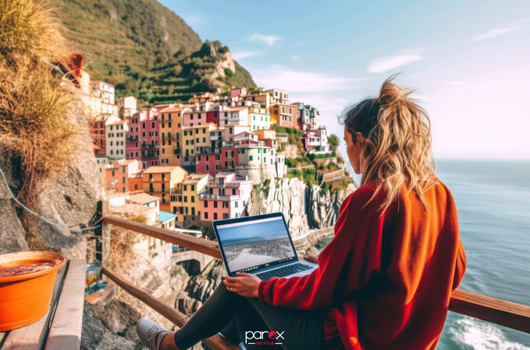


The Digital Nomad Visa is a type of residence visa issued to individuals who work remotely via the internet for companies or clients abroad. These individuals are typically freelancers, consultants, or remote employees whose jobs do not require physical presence at a workplace.
With the expansion of remote work following the COVID-19 pandemic, some countries like Italy have created this type of visa to allow non-European specialists to legally reside in the country while their income continues to be generated from abroad.
The Digital Nomad Visa is a suitable opportunity for those who want to live in a country like Italy, without needing to find local employment or make a large investment. In simple terms, the Digital Nomad Visa is a bridge between an independent lifestyle and legal immigration; an opportunity to live in countries like Italy while the individual’s source of income comes from outside that country.
Can I live in Italy with a Digital Nomad visa?
Yes. The Italian government approved a law in 2022 that allows citizens from countries outside the European Union to reside in Italy as a Digital Nomad or remote freelancer. This regulation was initially published as an emergency decree and later, with amendments, became law in March of the same year.
According to this law, individuals who meet the following conditions can apply for this visa:
- Hold non-EU citizenship;
- Be considered highly skilled or qualified professionals;
- Perform their work remotely via the internet;
- Work for companies outside Italy or on a self-employed basis.
In 2024, the Italian government published the implementing guidelines for this visa, specifying the minimum income requirement, the type of permitted work activity, and the conditions for assessing applicants’ eligibility.
In short, if you are a professional or freelancer working remotely with international income, you can legally live and work in Italy through this visa.
How to get a digital nomad residency in Italy
Requirements for obtaining an Italian Digital Nomad Visa
To obtain an Italian Digital Nomad Visa, the applicant must meet several key conditions. These conditions are designed so that only professionally qualified individuals with sufficient income can benefit from this type of residence.
- Non-European Citizenship: This visa is for nationals of non-EU countries. EU citizens do not need a visa.
- High qualification or skill: The applicant must fall into the category of "highly skilled or qualified" individuals. Usually, providing a university degree, strong work experience, or having a professional license can satisfy this condition.
- Relevant work experience: At least 6 months of professional activity in the field that will be carried out remotely or independently in Italy.
- Fully remote job: The professional activity must be carried out 100% remotely, using digital tools. Meaning there is no need for physical presence at a workplace.
- Employer or client outside Italy: The applicant must either work for a company or employer outside Italy, or collaborate as a freelancer with international clients. Individuals whose job is inside Italy are not eligible for this visa.
- Sufficient income: The minimum annual income for this visa is set at around 28,000 to 32,000 euros. This amount may increase slightly depending on the number of family members or the circumstances of the case.
- Private health insurance: Having international health insurance with adequate coverage for the duration of stay in Italy is mandatory.
- Certificate of no criminal record: The applicant must provide a valid certificate from their country of residence showing they have no criminal record in the last five years.
Who are eligible to receive the Italian New Zealand Digital Visa
All citizens from countries outside the European Union who have a specialized and skill-based job and can work remotely using digital tools are eligible for this visa. These individuals can work as freelancers (self-employed) or as employees of a foreign company.
Individuals who meet these conditions can apply for a stay of more than 90 days in Italy, even if this type of residence falls outside the usual work quotas. For stays of less than 90 days, obtaining a Digital Nomad Visa is not necessary. The main eligible categories are:
- Highly Skilled Professionals: Individuals with specialized work experience, higher education, or special technical skills (similar to the conditions for the EU Blue Card).
- Digital Nomads: Individuals who work in a self-employed and independent manner using the internet and digital tools.
- Remote Employees: Individuals who work remotely as employees for a foreign company or international project.
In general, if you are a skilled person who earns income via the internet without needing to be physically present at a workplace, you will likely be eligible for this visa.
Benefits of Italian New Zealand Digital Residence
Living in one of Europe’s most beautiful countries
Without the need for a work permit (Nulla Osta)
Renewability and convertibility to permanent residence
Converting residence to other residences in the future
Opportunity to discover Europe
Obtaining a tax code and access to financial services
The right to use public and social services
Possibility of family accompaniment
Without the obligation to work in the local market
Quality living experience at an affordable price
Outside the quota restrictions (Decreto Flussi)
Applying for and obtaining Italian Digital Nomad residence
Required documents for obtaining the Nomad Visa (National Visa)
- Passport with a minimum validity of 2 years for the applicant.
- Copy of the passport and copies of previous Schengen visas.
- Original and translation of the work contract or proof of freelance activity.
- Visa application form and 2 color photos.
- Proof of financial means and bank statement for a 6-month period, demonstrating an annual income of at least approximately 28,000 to 32,000 euros.
- Educational documents and work history with official translation and legalization by the Italian embassy.
- Certificate of no criminal record.
- Valid health insurance for Italy.
- Accommodation documents: Related to renting a home for residence in Italy.
- One-way flight reservation and travel insurance.
Costs for the applicant obtaining an Italian Nomad Visa
- PAREX service fee for obtaining the applicant’s residence.
- Travel expenses to Italy (including flight, hotel, transfer to the destination city).
- Costs related to buying or renting a home including: deposit, monthly rent, agency commission.
- Government payments such as insurance, revenue stamp = about 500 euros per person.
- Cost of document translation and legalization at the Italian embassy = about 300 to 700 euros.
- Italian embassy revenue stamp fee for the visa = 116 euros per person.
Family reunification residence for the parents of the main applicant
For parents over 65 years old: It is possible to obtain accompanying residence for parents over 65 in 2 cases. If the parents do not have another child in your country to take care of them, or if the son or daughter who is with the parents in your country themselves have a severe and serious illness.
For parents under 65 years old: If the parents are dependent on you to pay for their living expenses and do not have another child in their own country.
The validity period of the Italian Digital Nomad residence permit
- The residence permit (Permesso di Soggiorno) issued to Digital Nomad visa holders in Italy is issued for a maximum duration of 1 year.
- If the applicant continues to maintain the initial conditions (remote job, sufficient income, health insurance, etc.), this residence permit is renewable annually.
- Renewal requires re-verification of financial, professional, and insurance documents.
Residence for the spouse and children
- Legal spouse
- Children under 18 years old
- Disabled or dependent children over 18 years old
- Elderly dependent parents (only in specific circumstances and upon proof of strong dependency)
- The applicant’s own residence permit in Italy must have been issued.
- Having sufficient income according to the Italian standard of living that covers the total cost of the family.
- Have suitable accommodation in Italy: providing a rental agreement or deed of ownership, the house must meet health standards and have enough space for all family members.
There are 2 methods for family members to obtain residence and join the main applicant.
First method: After the main applicant receives their residence permit, their family travels to Italy with a tourist visa and obtains their family reunification residence permit in Italy. In this method, practically one year after the main applicant, the conditions and necessary documents for family reunification are prepared.
Second method: After the main applicant receives their residence permit, a Nulla Osta request for the family is applied for in Italy, and the family travels to Italy from the Italian embassy with a national family reunification visa and receives their residence permit.
Important note: Currently, the second method is not recommended, because according to the new laws, the applicant can obtain a Nulla Osta for their family after having 2 years of declared income.
- The duration of residence for the spouse and children will be exactly equal to the duration of the main applicant’s residence.
- If the Digital Nomad residence is renewed, the family’s residence is also renewable.
- Children can enroll in Italian schools, and the spouse may also receive work permission in some cases (depending on the residence conditions and permits issued).
- Summary: The Italian Digital Nomad residence not only provides the possibility of living in a European country for the remote worker but also provides suitable conditions for the legal accompaniment of the family.
Timeline for obtaining Italian Digital Nomad residence
Generally, the timeline for obtaining Italian Digital Nomad residence varies depending on the status of the documents, the destination city, and the response time of the relevant offices. The entire process, from start to receiving the residence permit, includes 2 main stages:
- Process inside your country: from start to receiving the residence visa while the applicant is in Iran, taking 3 to 5 months.
- Process inside Italy: from the applicant’s entry into Italy to receiving the residence permit.
The approximate time for each stage is as follows:
| Row | Different Stages | Description | Approximate Time |
| 1 | Preparation of applicant’s documents | Official translation of applicant’s documents and power of attorney with legalization from the Italian embassy | 1 to 2 months |
| 2 | Renting or buying a home in Italy | Time needed to find suitable accommodation according to your conditions and taste | 1 to 2 months |
| 3 | Obtaining a visa from the Italian embassy | Requesting an embassy appointment and submitting the visa application | 1 to 2 months |
| 4 | Travel to Italy and receiving the residence permit | Applying for the residence permit and fingerprint registration at the Questura | 2 to 4 months |
Permanent residence with the Italian Digital Nomad visa
Citizenship and passport with the Italian Digital Nomad visa