



















Bank Account, Taxes, and Driver’s License

How to Open a Bank Account in Italy

Opening a bank account in Italy is relatively simple, but it may vary slightly depending on the bank and your specific circumstances. Here is a general guide to help you open a bank account in Italy:

Guide to opening a bank account

Choose a bank

Research different banks in Italy to find one that meets your needs, considering factors such as fees, services offered, and the availability of English-speaking staff.

Preparing the necessary documents

You will typically need the following documents:

  • Passport
  • Residence permit
  • Identity card or Residenza certificate
  • Codice Fiscale (Italian national tax number card) – You can obtain this from the Agenzia delle Entrate (Revenue Agency) in Italy.
  • Proof of residence (utility bill, rental contract, or other documents showing your address)
  • Proof of income (such as salary slips or work contract)
Visit the bank branch

Go to the local branch of the bank you have chosen. Scheduling an appointment is recommended, especially if you need assistance in English.

The application form

The bank employees will provide you with an application form. Fill in the required information and provide the necessary documents.

ID Verification

You may need to have your identity verified. This could include an in-person meeting with the bank manager.

Select your account type
Choose the type of account that best suits your needs (for example, a current account for daily transactions or a savings account).
Get your bank card and documents.
Once your application is approved, you will typically receive a bank card and other relevant documents. Many Italian banks offer online banking services. If you wish, ask the bank staff about setting up online access to manage your account.
Activate Your Account
If your account requires an initial deposit, make sure to fund it to activate the account.

It is important to note that procedures may vary slightly from bank to bank. Some international banks may also have branches or partnerships in Italy and offer services in English. Additionally, it is a good idea to inquire about the fees associated with the account and whether there are any specific conditions for non-residents.

If you encounter language barriers, seek help from immigration or relocation services, or bring someone who speaks Italian with you to the bank.

Some of the best banks in Italy

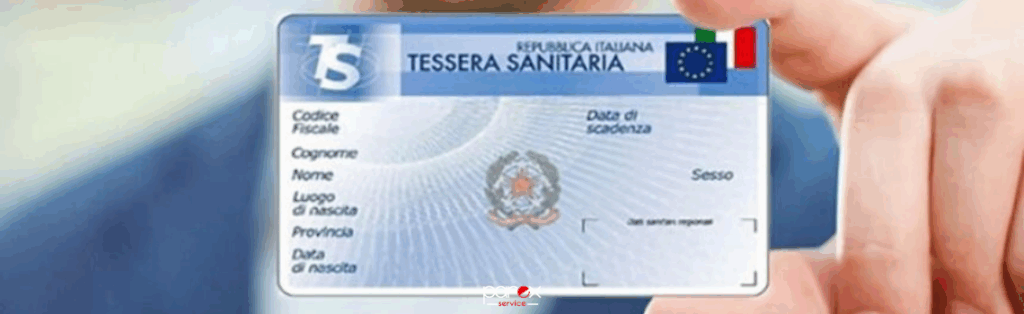
Tessera Sanitaria or Health Card, is an essential document for accessing healthcare services in Italy. Here are the general steps to obtain it:

How to get an insurance and health card

Residence registration (for non-EU citizens)

If you are a non-EU citizen planning to stay in Italy for more than three months, you must first obtain a residence permit (Permesso di Soggiorno). Go to the local police station (Questura) to start the application process.

Application for Tessera Sanitaria

Once you have your residence permit, you can apply for the Tessera Sanitaria. Visit the local health authority (Azienda Sanitaria Locale or ASL) in the area where you live. Bring the following documents with you:

  • Passport or ID card
  • Codice Fiscale – Italian national tax code
  • Residence permit (for non-EU citizens)
  • Proof of your residential address (e.g., a utility bill or rental contract)
  • Any other documents requested by the ASL
Complete the application form

Fill out the application form provided by the ASL. The office staff can assist you if needed.

Health check (for non-EU citizens)
Non-EU citizens may need to undergo a health check to determine eligibility for healthcare services. This may include a medical examination and vaccinations.
Wait for processing
After submitting your application, you may need to wait for the Tessera Sanitaria to be processed. The timeframe may vary, but you will typically be given a temporary certificate or receipt.
Get a health card
Once your application is approved, the Tessera Sanitaria will be issued to you. This card contains your personal information and a personal identification number.
Activating the card
To activate the Tessera Sanitaria, you may need to choose a general practitioner (Medico di Base) from the list provided by the ASL. This doctor will be your main point of contact for non-emergency healthcare.
Using the card
Whenever you need to access healthcare services, present your Tessera Sanitaria. The card ensures that you will be treated under the Italian National Health Service.

Italy has a complex tax system that includes various types of taxes at both the national and local levels. The main categories of taxes in Italy are:

Taxes in Italy

Income tax

Personal Income Tax (Imposta sul Reddito delle Persone Fisiche, IRPEF): This is the main tax on personal income. It is progressive, with rates ranging from 23% to 43%. There are also additional regional and municipal income taxes.

Corporate Income Tax (Imposta sul Reddito delle Società, IRES): Companies in Italy are subject to corporate income tax. The standard rate is 24%, but there may be additional regional surcharges.

VAT
Value Added Tax (Imposta sul Valore Aggiunto, IVA) is a consumption tax applied to most goods and services. There are various rates: the standard rate is 22%, reduced rates are 10% and 5%, and there are some exemptions for specific, agreed-upon items.
Social security benefits
Both employees and employers are required to contribute to social security. The contributions fund various benefits, including healthcare, pensions, and unemployment benefits.
Wealth tax
Italy does not have a specific wealth tax. However, taxes are applied to real estate.
Property tax
Imposta Municipale Unica (IMU): This is a municipal property tax on the value of real estate. The rate and calculation can vary depending on the municipality. Tassa sui Servizi Indivisibili (TASI): TASI is another property tax related to municipal services, but it is often incorporated into the IMU.
Inheritance and gift tax
Italy has an inheritance and gift tax (Imposta sulle Successioni e Donazioni) that applies to the transfer of assets between individuals.
Tax on financial transactions
Italy imposes taxes on certain financial transactions, including the buying and selling of securities.
Regional and local taxes
In addition to national taxes, there are also regional and local taxes that can vary depending on your location.
Revenue stamp
Revenue stamp (Imposta di Bollo) is a tax on legal documents, financial transactions, and certain contracts.

Obtaining a driver’s license in Italy involves several steps and is regulated by the Italian Ministry of Infrastructure and Transport. Here is an overview of the process:

Driving license in Italy

Residence conditions
To obtain an Italian driving license, you typically need to be a resident of Italy. If you are a non-EU citizen, you will likely need a valid residence permit.
Theory test
Start by studying the Italian traffic rules and regulations. You can find study materials at local driving schools or online. Take a theory exam (Esame Teorico) at the Motorizzazione Civile (Department of Motor Vehicles) or an authorized driving school. This exam tests your knowledge of traffic rules, road signs, and safety regulations.
First aid course and exam
Complete a first aid course (Corso di primo Soccorso) at a recognized institution.
Practical driving lessons
Enroll in a driving school (Autoscuola) for practical driving lessons. The number of required lessons can vary. Practice driving with a certified instructor.
Medical examination
To ensure you are physically fit to drive, get examined and certified by an authorized doctor.
Obtaining a learner's permit (Foglio Rosa)
After passing the theory exam, completing the first aid course, and some practical lessons, you can obtain a practical training permit (Foglio Rosa). This allows you to practice driving with a certified instructor or another authorized person.
Practical driving test
Schedule and take the practical driving test (Esame Pratico) with an examiner from the Motorizzazione Civile. The practical test assesses your ability to drive safely and follow traffic rules.
Getting a driver's license
After passing the practical test, you can receive your full driving license (Patente di Guida). The driving license is typically valid for ten years but must be renewed periodically.
Additional notes
  • Some driving schools may offer packages that include theory classes, practical lessons, and exam fees.
  • Keep in mind that this process may differ for different license categories (e.g., motorcycles, commercial vehicles).
  • If you have a driving license from another EU country, depending on the specific conditions, you may be able to exchange it for an Italian license without taking the driving test.

Obtaining Italian citizenship and passport

Acquiring Italian citizenship through residence involves a series of steps and meeting specific criteria. Here is a general guide: